Russells Reserve K&l Exclusive Single Barrel #376 Review
| Tavistock | |
|---|---|
| Stannary Town | |
 Tavistock town middle | |
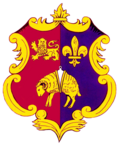 Coat of Arms | |
| Tavistock Location within Devon | |
| Population | 11,018 (2001 Census) |
| Os filigree reference | SX480740 |
| District |
|
| Shire canton |
|
| Region |
|
| Country | England |
| Sovereign state | United Kingdom |
| Post town | TAVISTOCK |
| Postcode district | PL19 |
| Dialling lawmaking | 01822 |
| Police force | Devon and Cornwall |
| Fire | Devon and Somerset |
| Ambulance | South Western |
| UK Parliament |
|


Tavistock ( TAV-iss-tok) is an aboriginal stannary and market town inside West Devon, England. It is situated on the River Tavy from which its proper noun derives. At the 2011 demography the three balloter wards (North, South and South W) had a population of thirteen,028.[1] It traces its recorded history back to at least 961 when Tavistock Abbey, whose ruins prevarication in the centre of the town, was founded. Its near famous son is Sir Francis Drake.[2]
History [edit]
Middle Ages [edit]
The expanse around Tavistock (formerly Tavistoke), where the River Tavy runs wide and shallow assuasive it to be easily crossed, and near the secure high ground of Dartmoor, was inhabited long earlier historical records. The surrounding expanse is littered with archaeological remains from the Bronze and Iron Ages and it is believed a village existed on the site of the present town long earlier the boondocks's official history began, with the founding of the Abbey.
The abbey of Saint Mary and Saint Rumon was founded in 961 by Ordgar, Earl of Devon. Later on destruction by Danish raiders in 997 information technology was restored, and at the time of the Conquest ranked as the wealthiest house in Devon, including the hundred and manor of Tavistock among its possessions. Among its famous abbots was Aldred, who crowned Harold Two and William I, and died Archbishop of York.[3]
In 1105 a Royal Charter was granted by Henry I to the monks of Tavistock to run a weekly "Pannier Market place" (and then chosen after the baskets used to carry goods) on a Friday, which withal takes place today. In 1116 a iii-day fair was also granted to marker the feast of Saint Rumon, another tradition that is still maintained in the shape of the annual "Goosey" off-white on the second Wednesday in October.

Past 1185 Tavistock had accomplished borough status, and in 1295 it became a parliamentary borough, sending two members to parliament. The abbey church was rebuilt in 1285. In 1305, with the growing importance of the expanse as i of Europe's richest sources of tin, Tavistock was one of the four stannary towns appointed past charter of Edward I, where tin was stamped and weighed and monthly courts were held for the regulation of mining affairs.[4]
Parish church [edit]
The church of Saint Eustachius (Eustace) (named afterwards the Roman centurion who became a Christian) was dedicated by Bishop Stapledon in 1318 though there are very few remains of that building today. It was rebuilt and enlarged into its electric current form betwixt 1350 and 1450, at which fourth dimension the Clothworkers' Aisle (an outer south aisle) was included, an indication of the growing importance of the textile industry to the local economy—the merchandise was protected by a 1467 statute. The whole is in the Perpendicular style and consists of a nave and chancel; both with two aisles, tower and outer south alley.
It possesses a lofty belfry supported on four open arches, i of which was reputedly added to accommodate the 19th-century "tinners" or tin can miners. Within are monuments to the Glanville and Bourchier families, likewise some fine stained drinking glass, one window being the piece of work of William Morris[iii] and another of Charles Eamer Kempe. Information technology besides has a roof boss featuring one of the and so-called 'Tinners' Hares', a trio of rabbits/hares joined at and sharing three ears between them. The font is octagonal and dates from the 15th century.[5]
Early modern period [edit]
The greater function of the abbey was rebuilt in 1457–1458. In 1552 two fairs on 23 Apr and 28 November were granted by Edward VI to the Earl of Bedford, then lord of the manor.[vi]
In the 17th century bully quantities of material were sold at the Fri market, and four fairs were held at the feasts of Saint Michael, Epiphany, Saint Mark, and the Decollation of John the Baptist. The charter of Charles II instituted a Tuesday market place, and fairs on the Thursday after Whitsunday and at the feast of Saint Swithin.[six] The town continued to prosper in the charge of the abbots, acquiring one of England'south showtime press presses in 1525. Tavistock remained an important centre of both trade and faith until the Dissolution of the Monasteries—the abbey was demolished in 1539, leaving the ruins still to exist seen around the centre of the town. From that fourth dimension on, the dominant forcefulness in the town became the Russell family, Earls and later Dukes of Bedford, who took over much of the country following the Dissolution.
Tavistock is tied from late medieval times with the Russells, the family name of the Earls of Bedford and since 1694, the Dukes of Bedford. This is conspicuously seen from the history of the town. The 2d title of the Knuckles of Bedford is the Marquess of Tavistock, taken as the courtesy title of the eldest son and heir to the dukedom, and illustrates the importance of this Devon boondocks, its hinterland and the minerals beneath it to the family's fortunes. It is believed that the Russell family retains considerable interests in the locality. Most recently, Robin, the brusk-lived 14th Knuckles, as Marquess of Tavistock, was a frequent visitor to the town along with his married woman, Henrietta. Andrew Russell is the 15th Duke of Bedford and Marquess of Tavistock.
It is this Russell family connectedness through the Bedford Estates which gives the proper name by ownership to Russell Square and Tavistock Square in London, famously home to the Tavistock Dispensary, and the bus-bombing of 7 July 2005.
Francis Drake [edit]
Effectually 1540 (some sources state 1542 as the exact year), Sir Francis Drake was born at Crowndale Subcontract, simply to the west of what is now Tavistock Higher. A Blueish Plaque is mounted on the current farmhouse, behind which Drake is believed to have been born, the original farmhouse having been dismantled and the stone transported for use in Lew Trenchard. He became a prominent figure of his historic period, a champion of Queen Elizabeth, the outset Englishman to circumnavigate the world from 1577 to 1580 and one of the English language commanders in the famously decisive victory against the Spanish Armada in 1588.
The famous statue of Drake on Plymouth Hoe is a copy of that on a roundabout on the A386 at the western cease of the town,[seven] with panels non replicated on the Hoe re-create. Drake later made his habitation at Buckland Abbey, almost 8 miles (13 km) away towards Plymouth, jointly owned/run by Plymouth City Council and the National Trust, and now a museum to Drake.[8]
Manufacture [edit]
Mines of copper, manganese, pb, silver and tin can were previously in the neighbourhood and the town played host to a considerable merchandise of cattle and corn, and industries in brewing and iron-founding.[3]
By the 17th century, can mining was on the wane and the town relied more than heavily on the cloth trade. Under the stewardship of the Russells the town remained prosperous, surviving the Black Expiry in 1625 (though 52 townspeople died). In the English Ceremonious War starting 1642, the town was at first held by the Parliamentarians (Francis Russell, the 4th Earl of Bedford was a leading figure in the parliamentarian movement), before afterward hosting King Charles I and his Royalist troops in 1643 afterwards the defeat of the Parliamentary forces at the Battle of Bradock Down. Tavistock's woollen manufacture also went into decline in the 17th century.
In 1694, William Russell, 5th Earl of Bedford became the first Duke of Bedford.
Late modern period [edit]
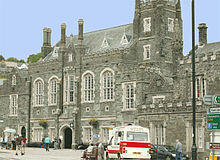
By 1800, cloth was heading the same mode as tin can had washed a century earlier, but copper was starting to be copiously mined in the area, to such an extent that past 1817 the Tavistock Culvert had been dug (virtually of the labour being performed by French prisoners of war from the Napoleonic Wars)[9] to conduct copper to Morwellham Quay on the River Tamar, where it could exist loaded into sailing ships. In 1822 the old fairs were abolished in favour of six fairs on the second Wednesday in May, July, September, October, November and December.[6]
In the mid-19th century, with nearby Devon Great Consols mine at Blanchdown ane of the biggest copper mining operations in the world, Tavistock was booming once more, reputedly earning the 7th Duke of Bedford lonely over £2,000,000. A statue in copper of the 7th Duke stands in Guildhall Square. The Duke built a 50,000 purple gallon (230 chiliad³) reservoir to supply the town in 1845, likewise as a hundred miners' houses at the southern end of town, between 1845 and 1855. There is a strong, recognisable vernacular "Bedford style" of design, exemplified most strikingly in Tavistock Town Hall and "Bedford Cottages" ubiquitous across Tavistock and much of the local area to the north and west, where the Bedfords had their estate and summertime "cottage" at Endsleigh Firm and Gardens, which since 2005 is the Hotel Endsleigh run past Alex Polizzi.
Tavistock was deprived of one member of Parliament in 1867 and finally disenfranchised in 1885. The railway came to the town in 1859, with connections to the Dandy Western Railway and the London and South Western Railway (LSWR). At around this fourth dimension the centre of town was essentially and ruthlessly remodelled past the 7th Knuckles of Bedford, including the construction of the current boondocks hall and Pannier Market buildings, and the widening of the Abbey Bridge, first built in 1764, and a new Drake Road ramped up northwards from Bedford Foursquare to the LSWR station. Tavistock North railway station opened to much acclamation and fanfare in 1890.[10] The population had peaked at around 9,000. By 1901 the population had halved, recorded equally 4,728. In 1968, following the Beeching Report, Tavistock Station closed, and in 1999 English Heritage listed the building as Form II. Buses provide public transport links with services to Plymouth and local areas.
Kelly College, a co-educational public schoolhouse, to the north-eastward of the boondocks, was founded by Admiral Benedictus Marwood Kelly, and opened in 1877 for the education of his descendants and the orphan sons of naval officers,[3] and is a pastiche of the Bedford and High Victorian styles of building. It later confederate with Mount House to form Mountain Kelly Foundation.
20th and 21st centuries [edit]
In 1911, the Bedford influence on the town came to an terminate after over 450 years, when the family unit sold most of their holdings in the area to meet expiry duties.[11]
W Devon Borough Quango is based in Tavistock, almost 500 metres north of Bedford Square at Kilworthy Park. There was a small police station under part of the Bedford building complex on Bedford Square; this has closed and a new ane is in Abbey Rise. The adjacent celebrated Magistrates Court has also closed and the nearest criminal court is now at Plymouth.
In 1926 a meeting was held in Tavistock with representatives of the United kingdom regime and United kingdom of great britain and northern ireland scientific musical instrument makers. A comparing was made on Dartmoor betwixt UK theodolites and their European competition, specially the Swiss Wild T2 theodolite. One outcome of this conference was the 1930 "Tavistock" theodolite by Cooke, Troughton & Simms.[12]
In 1933 the long-disused canal was put to use providing hydroelectric ability for the area.[thirteen]
A war memorial in Bedford Square commemorates the townsfolk killed in the First and Second World Wars.[14] Many families across U.k. exercised their right not to have their family members named on these public memorials. In 2006 information technology was planned to move the monument to a site in the graveyard of the Parish Church, but due to local opposition this did not happen.[15]
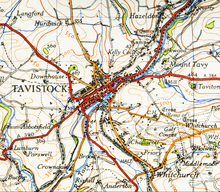
A map of Tavistock from 1946, showing the layout of the town and location of the two railway stations.
Tavistock had two railway stations, both at present closed. Tavistock Southward was the Great Western Railway'south station, on the route between Launceston and Plymouth. This was closed and mostly dismantled between 1962 and 1965. The station was sited to the south of Bedford Square, simply over the span and to the right—now a council depot: no trace of the station remains. Tavistock Northward was the Plymouth, Devonport and South Western Junction Railway's station, operated by the London and South Western Railway, on the road between Lydford and Plymouth via Bere Alston. This opened on two June 1890 and closed on half dozen May 1968. The main station building survives as railway-themed bed and breakfast accommodation while the extensive goods yard is now known every bit Kilworthy Park and houses the offices of West Devon Borough Council. The railway for effectually a mile south of Tavistock N station is open to the public as a footpath and nature reserve and i can walk across the viaducts that overlook the boondocks.
The trackbed of the Tavistock Northward route is nearly intact to Bere Alston, where it joins today's Tamar Valley Line. The possible re-opening of a rail link has been discussed for a number of years. Applied science assessment shows the rail-bed, bridges and tunnels to exist in audio status. In 2008 a housing developer offered to rebuild the railway to Bere Alston (from a new station slightly due south of the town) if they were immune to build 800 properties.[16] This has likewise encouraged speculation near restoring the Tavistock-Okehampton track link, which could provide an alternative to the Devon coastal primary line to link the South West Region with the remainder of the country.[sixteen] In December 2010 the programmer published an update on the possibility of reinstating the line betwixt Tavistock and Bere Alston and hence providing a railroad train service between Tavistock and Plymouth.[17] In April 2010 the Liberal Democrats had suggested that a Tavistock-Plymouth service could be included in the runway expansion plans should they win the 2010 General Election.[18]
In 1986, the boondocks's two newspapers, the Tavistock Gazette (founded in 1857) and the Tavistock Times (established in 1920) merged to course the electric current weekly publication, the Tavistock Times Gazette, with a apportionment of around 8,000.[nineteen] The newspaper is owned by Tindle Newspaper Group. The newspaper celebrated its 150th anniversary in 2007, with a visit from the Prince of Wales and Duchess of Cornwall.[xx]
In July 2006 Tavistock was named the eastern Gateway to the Cornish Mining World Heritage Site, which runs westward through the Tamar Valley and Slap-up Consols Mine, downwards the spine of Cornwall to Lands Terminate.[21] This £75 million project is likely to bring more than tourists to Tavistock. A£i.1 million Earth Heritage Site Interpretation Middle, planned for 2007, to be built in the area of the Guildhall, and overlooking the River Tavy[15] has not been accomplished.
A local community group known as "Tavistock Frontward" have been negotiating to have over the Guildhall circuitous with police and English Heritage endorsement, with leaseback of the existing law station to Devon & Cornwall Police, while developing the Guildhall itself.[22]
Geography [edit]
Tavistock lies on the border of Dartmoor, around 24 kilometres (14.9 mi) north of Plymouth on the A386, with a population of 11,018.[23] The boondocks is centred on the paved assiduities of Bedford Foursquare, effectually which are plant St. Eustachius' Church and the Abbey ruins, to the due west, the Grade 2-listed town hall, the disused old Guildhall/magistrates' court buildings, and Pannier Market buildings backside the boondocks hall. Abbey Bridge crosses the River Tavy to the s, while Westward Street and Duke Street, on either side of the north terminate of the square, form the main shopping areas, with the indoor [Pannier] market running behind Knuckles Street.
Plymouth Road, the A386 heading westward from the centre of the square, is home to much of the town'south tourist trade, with many hotels and bed and breakfast establishments, as well as the town's omnibus station. Between Plymouth Road and the Tavy is the park, known locally as the Meadows, along with machine parks, the Wharf theatre, cinema and culture centre, and a public recreation pool. West of the Meadows are found the substantial playing fields and buildings of Tavistock College, reached by an underpass below the A386. Farther southward forth the Plymouth Road/A386 lie industrial estates, supermarkets and other large retail outlets. To the north and east of town lies Whitchurch Downwardly, where Dartmoor begins immediately.
Climate [edit]
Tavistock has an oceanic climate (Köppen climate classification Cfb).
| Climate data for Tavistock | |||||||||||||
|---|---|---|---|---|---|---|---|---|---|---|---|---|---|
| Month | Jan | Feb | Mar | Apr | May | Jun | Jul | Aug | Sep | Oct | Nov | Dec | Year |
| Average loftier °C (°F) | eight (46) | 8 (46) | ix (48) | 12 (54) | 14 (57) | 17 (63) | nineteen (66) | 19 (66) | 17 (63) | 14 (57) | 11 (52) | 9 (48) | xiii (55) |
| Average low °C (°F) | three (37) | iii (37) | 4 (39) | v (41) | 8 (46) | 11 (52) | 13 (55) | 13 (55) | 11 (52) | ix (48) | half dozen (43) | four (39) | 8 (46) |
| Source: Atmospheric condition Channel[24] | |||||||||||||
Religious sites [edit]
- Run across also Tavistock Abbey
- For the parish church of St Eustachius, see above, Parish church
- The Roman Catholic Church of Our Lady of the Assumption and St Mary Magdalen, Fitzford, was built at the expense of the Duke of Bedford in 1867. It is an ambitious building in the neo-transitional style and the tall spire is conspicuous from the high footing surrounding the town.[25] This church building was intended equally a identify of worship for miners. It fell into disuse and was bought in 1952 for utilise every bit a Roman Cosmic church.
Didactics [edit]

Church of St Mary Magdalene
State [edit]
Most secondary education is provided past Tavistock College, a state-funded specialist Language College with almost 2,000 pupils,[26] fatigued from a catchment area of about twenty km (12 mi) radius. The college has links with Nihon, Uganda, Spain and India where staff exchanges and educatee visits and projects take identify.[26] Since 2006, the college has organised concerts locally under the name of ParkLife; a ParkLife festival was held in 2007 and 2008.[27] It recently went into special measures only equally of September 2011, came out and is progressing well.
Some children who pass the optional 11-Plus exam at a high level travel to one of the three remaining grammar schools in Plymouth. Others who get out school at xvi attend the City College C of F E there. Tavistock has a choice of principal schools: Church building of England St Peter's and also St Rumon's, together with Devon County Council's Tavistock Community Primary and Whitchurch Primary.
Independent [edit]
Mountain Kelly Schoolhouse is the independent school in Tavistock. It has ii primary sites, the College which is situated on Parkwood Road and the Preparatory School which is situated on Mount Tavy Road. The school has 570 pupils betwixt the ages of 3 to 18. Mount Kelly was formed in 2014 later on 2 contained schools, Kelly College and Mount House Schoolhouse merged.[28]
Life and events [edit]
Market village and shopping middle [edit]
Tavistock is a small marketplace town, providing shopping and entertainment for its residents, many small outlying villages and the local farming community. It is a centre for the Due west Devon and Dartmoor tourist trade. It is a fast-growing dormitory area for commuters working in Plymouth and has a sizeable and rapidly growing retired population, perchance drawn by the rural tranquillity and scenery, giving Tavistock an boilerplate resident age of 44[23]
The Market continues to operate in the large covered market edifice, the Pannier Market; the master market is on Fridays, on other days the market hosts specialised events, such equally craft fairs and antiques fairs.[29] A Farmers' Market takes identify in the Square fortnightly and has been voted All-time Farmer's Market in the South West.[thirty]
In 2005 Tavistock was voted 'Best Market Town' in England and in 2006 'All-time Food Town',[31] largely on the forcefulness of the many contained food shops and suppliers in the town and nearby, such every bit a long-established family grocer and delicatessen in Beck St and the cheese shop behind the Pannier market. The town also became Devon's 2nd Fairtrade Town (in 2006).[32] In 2006 the town was in the news for having successfully cold-shouldered to closure the local branch of McDonald's.[33] A co-operative of the supermarket chain Lidl was built in its place.
Events [edit]
The biggest upshot in the boondocks'due south calendar is the annual Tavistock Goose Off-white (known locally as "Goosey Fair") which has existed since 1116. Information technology occurs on the second Wednesday of October, and takes over much of the town for several days either side, drawing crowds which far outnumber the resident population. Traditionally, the Fair was an opportunity to buy a Christmas goose, with plenty of fourth dimension to fatten the bird before Christmas; present, along with a multitude of gypsy street vendors selling a vast range of wares, there are all the rides and games associated with funfairs, such as fortune tellers.[34]
There is an almanac two-day garden festival held on the Spring Banking company Vacation weekend [ane] and a funfair with a two-twenty-four hours Balloon Fiesta each August depository financial institution holiday weekend. In May there is an almanac "Tavistock Music & Arts Festival"

Semi-reproduction Tavistock Penny Token struck at Bigbury Mint, Devon
[2]
In 2010, the town was called to exist a stage depart town in the Bout of Britain cycle race.
On the start Sunday in October, the annual Abbots Way Walk finishes in Tavistock. Started in 1962, this challenge walk starts at Buckfast Abbey and participants walk 24 miles (39 km) across Southern Dartmoor to cease at Tavistock.[35] It is now organised past Tavistock & District Outdoor Education Forum. In 2020 this event volition be on Lord's day four Oct and will exist the 58th year the event has been organized.
Civilisation and sport [edit]
Tavistock's coat of arms is blazoned "Per pale, gules and azure, a fleece banded; a chief, dexter a lion passant gardant, sinister a fleur-de-lys, all or". The earliest record of these arms is in 1684. The fleece refers to the wool trade and the fleur-de-lys probably to Our Lady, joint patron of Tavistock Abbey. The town's motto is "Crescit sub pondere virtus", meaning "virtue flourishes under a burden".[36]
Tavistock Penny Token [edit]
Bigbury Mint Ltd, medal makers based nearly Plymouth in Devon, produce a semi-reproduction of the Tavistock Penny Token[37] which is distinguished from the original by the Bigbury Mint marking stamped on both sides of the coin. At that place is an example of the original coin held in the Science Museum Collection.[38] The Bigbury Mint reproduction coin is struck in copper every bit a commemoration of the proud mining history of the boondocks, the obverse of the coin features the Tavistock fleur-de-lys and the reverse of the coin features a carving of the mine, along with the words "Devon Mines, 1811".
Literature [edit]
Tavistock was the birthplace of the poet William Browne.[39] The town is mentioned in some of Sir Arthur Conan Doyle's Sherlock Holmes adventures, including The Hound of the Baskervilles and "The Adventure of Silver Bonfire". Information technology is also receives a mention in R. D. Blackmore'south classic Lorna Doone and Neal Stephenson's novel, The System of the World. Anna Eliza Bray was the writer of The Borders of the Tamar and the Tavy (1836), an account of the traditions and superstitions of the neighbourhood of Tavistock in the class of letters to Robert Southey.
Sport [edit]
Tavistock has one senior football game team, Tavistock A.F.C. and two inferior football game teams, Tavistock Town and Tavistock Thistles. Together the three clubs form Tavistock Community Football Club offering coaching and competition to players of all ages from 5 years former to veterans. In that location is besides a rugby team renowned for a very large and agile minis and junior department, Tavistock Rugby Football Guild whose colts (under eighteen'due south) are currently the Devon Plate Champions, a cricket social club, tennis club and a very active athletics club.
The Tavistock & District Outdoor Didactics Forum (OEF) provides over 3,500 sessions each year for young people in outdoor activities. It also organizes three 10 Tors Teams each year and the Abbots Manner Walk[ citation needed ]and was awarded The Queen's Award for Voluntary Service in 2013.
Foreign relations [edit]
Tavistock has long been a town of much interest to tourists and attracts many visitors from effectually the globe, for example Japan, French republic and Italy. The local college has many links with foreign schools and is known for its teaching of languages.[ citation needed ]
Twin towns [edit]
The town maintains twinning links with Pontivy in France, since 1958 and Celle in Deutschland.[40] [41]
-
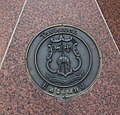
Glaze of arms at sister city Celle (Federal republic of germany), granite artwork below signpost
Notable residents [edit]
- Mary Colling, poet and domestic servant of Tavistock.
- Sir Francis Drake was mayor of Tavistock
- Rosie Huntington-Whiteley, a model, grew up on a farm nigh Tavistock.[42]
- Pete Quaife, the Kinks bass player, was born in the town.[43]
- Olympians Kate Allenby and Heather Roughshod both accept ties with Tavistock.[44]
- Graham Dawe (England, Sale and Bathroom rugby hooker) and Rob Baxter (the Exeter Chiefs and England rugby jitney) were both born in Tavistock.[45] [46]
- The hymn writer Elizabeth Parsons was also born in the town.[47]
- Michael Howat (born 1958), cricketer
- William Thomas Goode (died 1932), journalist and academic[48]
See also [edit]
- Tavistock Canal
- S Devon and Tavistock Railway
- Tavistock (Uk Parliament constituency)
- Exeter to Plymouth railway of the LSWR
Notes [edit]
- ^ "Tavistock update" (PDF). Archived from the original (PDF) on 23 September 2015. Retrieved 23 November 2014.
- ^ Turner, Michael (2005). In Drake's Wake - The Early Voyages. Paul Mould Publishing. ISBN978-1-904959-21-2.
- ^ a b c d Chisholm 1911, p. 457.
- ^ Chisholm 1911, pp. 457, 458.
- ^ Pevsner, N. (1952) South Devon. Harmondsworth: Penguin Books; pp. 275-77
- ^ a b c Chisholm 1911, p. 458.
- ^ Moseley, Brian (June 2010). "Drake's Statue". The Encyclopaedia of Plymouth History. Plymouth Data. Archived from the original on 9 October 2010. Retrieved 13 Feb 2015.
- ^ "Buckland Abbey". National Trust website. National Trust. Archived from the original on iii July 2007. Retrieved 28 June 2007.
- ^ Devon County Council: Local Studies Archived 2 March 2008 at the Wayback Machine
- ^ Fryer, South. (1997) The Building of the Plymouth, Devonport & South Western Junction Railway. ISBN 0-9529922-0-5, ISBN 978-0-9529922-0-ii
- ^ "The 'Sale of the century' in 1911 that changed the face of Tavistock". Tavistock Times. 23 June 2011. Retrieved two October 2021.
- ^ Anita McConnell, Instrument Makers to the Globe Pp. 80-82 ISBN 978-1850720966
- ^ Greeves, Tom (Apr 2003). "The Tavistock Culvert - A Review" (PDF). Tamar Valley Service. Archived from the original (PDF) on 25 September 2006. Retrieved 30 May 2007.
- ^ "Tavistock". War Memorials Online. Retrieved 2 October 2021.
- ^ a b Tavistock Town Council (ii August 2006), Minutes of a Town Coming together of Tavistock, Tavistock Town Council, archived from the original on 23 June 2007, retrieved 28 June 2007
- ^ a b "Tentative Talks Held Over Rail Line Reopening" (Printing release). West Devon Borough Council. 27 July 2005. Archived from the original on 29 September 2007. Retrieved 28 June 2007.
- ^ "Updated Position Argument, Tavistock to Bere Alston Community Rail Proposals" (PDF). Kilbride Customs Runway. Dec 2010. Archived from the original (PDF) on 3 February 2013. Retrieved 14 January 2012.
- ^ BBC News Online (5 April 2010). "Lib Dems plan track expansion by cutting road projects". Retrieved 5 Apr 2010.
- ^ "Tavistock Times Gazette History|Tavistock Times Gazette". Tavistock Today website. Archived from the original on 27 Feb 2007. Retrieved 28 June 2007.
- ^ Honey, Jane (18 May 2007). "Duke and Duchess join paper'due south anniversary celebrations". Tavistock Times Gazette. Tindle Newspapers Ltd. Archived from the original on 10 Oct 2007.
- ^ "Mining landscape of Cornwall and Due west Devon becomes a UNESCO Globe Heritage Site" (Press release). Department for Culture, Media And Sport. thirteen July 2006. Archived from the original on 30 September 2007.
- ^ "Tavistock Forward Almanac General Meeting minutes". Tavistock Forward. 25 May 2006. Archived from the original on 13 May 2007. Retrieved 28 June 2007.
- ^ a b Function for National Statistics (2001), 2001 Census, statistics for Tavistock Parish, Office for National Statistics
- ^ Tavistock travel information Archived eighteen October 2015 at the Wayback Machine Weather Channel United kingdom Retrieved 4 April 2009
- ^ Pevsner, N. (1952) Due south Devon. Harmondsworth: Penguin; p. 277
- ^ a b "The College". Tavistock Higher website. Tavistock College. Archived from the original on 10 June 2007. Retrieved 28 June 2007.
- ^ "Parklife Party Homepage". Parklife website. Archived from the original on 29 September 2007. Retrieved 28 June 2007.
- ^ "History | Mount Kelly | Kelly College | Mount House Schoolhouse". www.mountkelly.com. Archived from the original on 18 October 2015. Retrieved fourteen October 2015.
- ^ "Tavistock Pannier Marketplace website". Archived from the original on 17 July 2007. Retrieved 28 June 2007.
- ^ "Tavistock Farmers Market website". Archived from the original on 25 June 2007. Retrieved 28 June 2007.
- ^ Harrison, Peter (12 Oct 2005). "No demand to shop around in Tavistock". Western Morning News. Archived from the original on xiii May 2007.
- ^ "Fairtrade towns". Fairtrade Foundation. 18 June 2007. Archived from the original on 30 June 2007. Retrieved 28 June 2007.
- ^ "McDonald'due south forced to shut from lack of patronage in healthy town". Thisislondon.co.uk. Archived from the original on 14 September 2010.
- ^ "Goose Fair". Tavistock Town Council website. Tavistock Boondocks Council. Archived from the original on 23 June 2007. Retrieved 28 June 2007.
- ^ "The 52nd Abbot'due south Mode Walk". Dartmoor National Park Potency. Archived from the original on 2 March 2016. Retrieved 20 March 2016.
- ^ "Tavistock Town Council; About Tavistock; The Tavistock Glaze of Arms". Archived from the original on 26 May 2019. Retrieved 26 May 2019.
- ^ S, +Tim; les (22 March 2016). "Tavistock Pennies | Legendary Dartmoor". Retrieved 7 March 2022.
- ^ "Tavistock penny token | Science Museum Group Collection". collection.sciencemuseumgroup.org.uk . Retrieved 7 March 2022.
- ^ Cousin, John West. (1910). A Short Biographical Lexicon of English Literature. London: J. M. Dent & Sons Ltd. ISBNane-4099-6436-1. Archived from the original on 23 April 2007. Retrieved 28 June 2007.
- ^ "UK Twin Towns". Dorset Twinning Clan. 11 May 2007. Archived from the original on 24 June 2007. Retrieved 28 June 2007.
- ^ "Stadt Celle". celle.de. Archived from the original on eleven June 2011. Retrieved five Jan 2010.
- ^ Pukas, Anna (seven May 2011). "Is this the Sexiest Adult female in the World?". Daily Express. UK. Archived from the original on eight December 2012. Retrieved 3 February 2016.
- ^ Rogan, Johnny (2015). Ray Davies: A Complicated Life. Random Firm. p. 64. ISBN9781847923318. Archived from the original on 15 May 2016. Retrieved 3 February 2016.
- ^ Bull, Andy (22 August 2008). "Olympics- High v as Roughshod takes unexpected silver in a truthful test of endurance". The Guardian. London. Archived from the original on 25 May 2019. Retrieved 3 February 2016.
- ^ "Graham Dawe England". ESPN. Archived from the original on iii July 2016. Retrieved 3 Feb 2016.
- ^ "Rob Baxter". Exeter Chiefs. Archived from the original on 13 April 2016. Retrieved 3 Feb 2016.
- ^ J. C. Hadden, 'Parsons, Elizabeth (1812–1873)', rev. Rosemary Mitchell, Oxford Dictionary of National Biography, Oxford University Press, 2004 accessed 17 January 2016 Archived 24 July 2021 at the Wayback Machine
- ^ "Tavistock". Devon and Exeter Gazette. 12 Baronial 1932. page 13, column vi.
References [edit]
- This article incorporates text from a publication now in the public domain:Chisholm, Hugh, ed. (1911). "Tavistock". Encyclopædia Britannica. Vol. 26 (11th ed.). Cambridge University Press. pp. 457–458.

External links [edit]
- Local authorities: Tavistock Town Council
- Tavistock information from Devon Canton Quango
- Tavistock Community Information Website
- Local Information
- Tavistock at Curlie
caldwellmancepoperes.blogspot.com
Source: https://en.wikipedia.org/wiki/Tavistock
Belum ada Komentar untuk "Russells Reserve K&l Exclusive Single Barrel #376 Review"
Posting Komentar